

You own rentals, or you plan to. But when someone asks how your properties are really doing, or what you’re worth, you have to guess. Without one clear picture, it’s hard to know if your last decision helped you or hurt you.
A lot of the owners we work with want their rentals to build wealth, not take over their week. Our job is to handle the day-to-day so you can focus on the numbers that matter.
I’m Schuyler with Cedar Ridge Management. The habit I credit most for my own progress is simple: keep a personal financial statement, and update it every month.
Why a monthly personal financial statement matters
I started doing this in 2011, and my net worth was depressing. Honestly, it was an awful negative ($76,000). But I believe we’re called to be good stewards of what we’ve been given, and this habit is one of the best ways I know to do that, and to multiply it. If you keep a personal financial statement and update it regularly, you too will become financially free.
Here’s why it works:
You get an accurate picture of where you stand. No more guessing.
Your financial IQ goes up every time you fill it out. You see whether that month’s choices helped or hurt.
You become a better real estate investor. Real estate investing is managing money. Month by month, you see how each investment affects your wealth, your cash flow and your freedom.
If you want to go deeper, four books shaped how I think about this: Rich Dad Poor Dad by Robert Kiyosaki, The Millionaire Next Door, The Millionaire Mind by the same author, and Pillars of Wealth by David Greene. I’ve read each of them many times. The Millionaire Next Door makes a point that stuck with me: millionaires spend far more time working on their finances than the average person does.
How the template is laid out
You’ll find a link to the template HERE (or on our owners resources tab) It has two parts:
The top is your income statement. Income minus expenses gives you your net monthly cash flow. Think of it as the profit of your life.
The bottom is your balance sheet. What you own minus what you owe gives you your net worth.
Fill in the yellow cells. Leave the green cells alone, because they hold the formulas.
The numbers to watch on your income statement
Enter your earned income, the passive income from your rentals, and anything from stocks, bonds or dividends. Then enter your monthly expenses. The template does the rest. Here’s what I want you watching:
Savings rate. How much of your income you keep. You want it climbing every month, because that’s the money you’ll invest later. My tip: every time money lands in your checking account, move a percentage into giving, savings and investing before you spend on anything else.
Financial freedom ratio. Your passive and portfolio income divided by your expenses. When it passes 100%, your investments cover your living costs. That’s retirement, or exiting the rat race. Start watching it now, not 40 years from now.
Taxes. Taxes will be your biggest expense in life. Track them, and you’ll see how your job and investment decisions change what you pay. Pay less, and you have more to invest.
Housing. This is a huge opportunity. A $3 coffee won’t move the needle much. But if your mortgage is $2,000 and someone living with you pays $1,000, that’s real money toward your goals. That’s house hacking.
Doodads. What you spend on cars, boats and toys compared to your total assets. As Robert Kiyosaki says, if it doesn’t pay you, it’s a doodad.
Return on assets. You want this rising over time.
Wealth in months. If you sold everything and quit working, how many months could you live? That’s how wealthy you really are.
Your balance sheet: two different net worths
Enter your bank accounts, investments, businesses and the equity in your rentals. Then list what you owe: credit cards, car loans, school loans and your mortgage.
Notice something. Your rentals sit up top with your productive assets. Your home sits lower, with your doodads. It’s still an asset on paper, but it takes cash from you every single month.
That’s why the template shows two net worth numbers:
Net worth for your banker. A lender counts everything, including your home and your cars.
Net worth for accreditation. This leaves out your home and your doodads. It’s the number used to decide whether you qualify for certain investments that aren’t open to the public.
I can’t stress this enough: focus on the second number. A beautiful house with lots of equity isn’t moving you toward financial freedom if it isn’t paying you. Focus on what pays you, and you’ll make better decisions.
The property financial statement
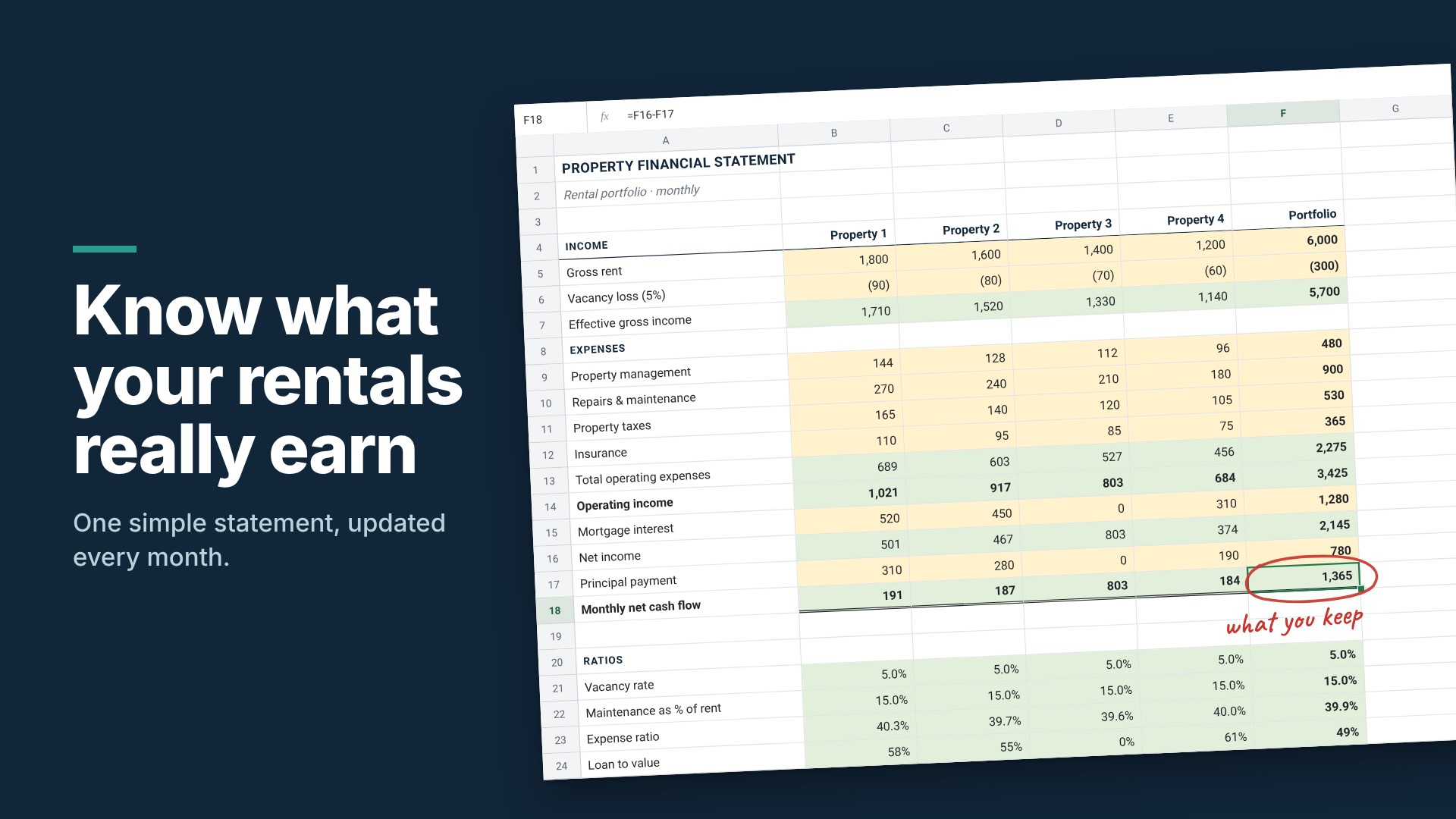
The second tab tracks your rentals the same way, with an income statement on top and a balance sheet below. It’s built for four properties, and you can add rows for more.
For each property, enter the rent, any vacancy loss, and your expenses: property management, repairs, property taxes and insurance. Then add your mortgage interest and principal. You’ll see three numbers, and it’s worth knowing the difference:
Operating income is your income minus operating expenses. It’s what the property would earn with no loan on it.
Net income is your operating income minus your financing costs.
Cash flow is your net income minus your principal payments.
Then track a few ratios every month, and compare them year to year:
Vacancy. I use 5%, based on where I invest in eastern North Carolina. What’s the number for your properties?
Maintenance as a percentage of rent. I use 15%, because I’ve tracked it since I bought my first rental in 2011. A brand-new house will run lower in its first 5 to 10 years than it will in years 20 to 30.
Expense ratio. The well-known 50% rule assumes about half of your rent goes to expenses. Your real number helps you size up the next deal.
Loan to value. Your loan divided by the property’s value. Lenders often call 70 to 75% safe. I’m conservative. I like about 50%, because I want to survive any downturn and sleep well at night.
Two setup tips – manage your investments like a pro
Separate your rental money. Keep one checking account and one savings account for your rentals, apart from your personal accounts. I used to have a checking account for every property. After about three, the bookkeeping got very hard. Now I keep one of each, with a minimum balance in both. Anything above those minimums is available to invest.
Value your rentals conservatively. A good-enough shortcut: average the Zillow and Realtor.com estimates.
The two tabs connect. Your rentals’ net income flows into your personal income statement, and your rental equity flows into your personal balance sheet. Keeping them separate lets you see clearly how your rentals affect your whole financial picture.
Questions about any of this? Email me at schuyler@cedarridgemgmt.com.
What happens if you skip it
Without a monthly picture, it’s easy to miss a property that’s quietly costing you, or a habit that’s slowing you down. The fix takes one sitting a month.
A guide for the day-to-day
You shouldn’t have to be an expert to have a rental property. But if you want your rentals to build wealth, someone has to handle the daily work so you can keep your eyes on the numbers. Cedar Ridge is built by investors, for investors. We manage 240+ homes across the Leland-to-Swansboro coastal corridor and hold 4.8 stars from 207 Google reviews. And you only pay a management fee if we successfully collect the rent due.
As John T. put it: “Great management company who cares about the details! You all continue to meet expectations and go above and beyond to make sure my property is cared for and stays rented. Erin, thank you for the consistent communication and keeping me up to date!”
Here’s how it works
Get your free rental analysis. It lands in your inbox within minutes.
Talk with our team. A call to understand your situation, then a visit to see your home in person.
Hand it off. Sign one agreement, and we take it from here.
Your home is cared for, the rent is collected for you, and you only hear from us when something important happens. The rental stops being something you think about every day. You keep your time for the monthly habit that actually builds wealth.
Running the numbers on a property you’re not sure about keeping? Not sure renting is right for you? Answer four simple questions to find out if renting out your home makes sense, or if selling is the better choice. Get the Free Guide
Frequently asked questions
How often should I update my personal financial statement?
Every month. Each update shows you whether that month’s decisions helped or hurt.
Where can I get the template? HERE
Should my home count toward my net worth?
A lender will count it. But your home takes cash from you every month, so focus on your net worth without it. That’s the number that tracks your progress toward financial freedom.
Do I need separate bank accounts for my rentals?
Yes. Keep one checking and one savings account for all of your rentals, separate from your personal money. One per property gets hard to manage fast.
How do I estimate what my rental is worth?
Be conservative. Averaging the Zillow and Realtor.com estimates gives you a good-enough number.
This article is for general educational purposes and isn’t legal or tax advice. Every situation is different, so for advice about yours, talk with a licensed attorney or CPA.